

What Is Automated Penetration Testing? A Guide to Red, Blue, and Purple Team Automation
Picture this. It's a Tuesday morning in Berlin, or maybe Amsterdam, and your security team is staring down a backlog of 200 unpatched vulnerabilities. Someone asks the question every CISO dreads: "But which of these can actually be exploited?"
Nobody knows. And that, right there, is the entire reason automated penetration testing exists.
For years, penetration testing meant hiring a small army of ethical hackers once or twice a year, waiting weeks for a PDF report, and then quietly hoping nothing changed in your network before the next engagement. It worked, sort of. But in a world where a new cloud misconfiguration can appear before lunch and disappear by dinner, testing your defences twice a year is a bit like checking your smoke alarm once every leap year.
So let's talk about what's replaced that approach, why European security leaders are paying close attention to it, and how red, blue, and purple team automation actually fit together.
Insert image of a security operations centre with dashboards showing live attack simulations
What Is Automated Penetration Testing?
Automated penetration testing uses software, and increasingly AI agents, to find and actively exploit security weaknesses the way a real attacker would. Not just flag them. Exploit them.
That last part matters more than it sounds. A vulnerability scanner will tell you "this server might be vulnerable to X." Automated penetration testing tools go further. They chain weaknesses together, harvest credentials, move laterally, and prove impact, all without a human sitting at a keyboard for every single step. Think of it as the difference between a smoke detector and a fire drill. One tells you there's a risk. The other shows you exactly how the fire spreads through your building.
Fair warning: on paper, this sounds a bit too good to be true. Autonomous hacking, running itself, on your production network? But the technology has genuinely matured. Platforms now run production-safe simulations on a recurring schedule, something that simply wasn't affordable or practical when every test needed a consultant on a plane.
How Does Automated Penetration Testing Work?
Here's the general flow, and it mirrors how a human attacker actually thinks:
- Reconnaissance – the tool maps your attack surface: domains, cloud assets, exposed services, identities.
- Scanning – it identifies potential weaknesses across that surface.
- Exploitation – it actively attempts to exploit findings, not just report them.
- Post-exploitation – it checks what an attacker could reach next: sensitive data, admin credentials, critical systems.
- Reporting – it produces evidence, not guesswork, showing exactly how a breach could unfold.
No dramatic hoodie-wearing hacker required. Just a very persistent, very fast piece of software doing the boring reconnaissance work that used to eat up the first three days of any manual engagement.
Automated Penetration Testing vs Manual Testing
This is the question that comes up most often, usually within the first two minutes of any conversation with an IT director. Is automation actually as good as a human?
Short answer: not entirely, and it doesn't need to be.
A 2025 Stanford study comparing AI agents against professional testers found something worth sitting with. Nearly 80% of human testers found a critical remote code execution flaw that every AI agent in the study missed. Automation is brilliant at scale, speed, and consistency. It's still not as creative as an experienced human chasing a hunch.
Automated Penetration Testing vs Vulnerability Scanning: What's the Difference?
People mix these up constantly, and honestly, vendors don't always help. A vulnerability scanner checks a system against a database of known issues and flags anything that matches. It's useful, but it's a list of maybes.
Automated penetration testing takes that list and asks, "okay, but can I actually break in with this?" It attempts the exploit, chains it with other weaknesses, and shows you the real-world consequence. One gives you a spreadsheet of possibilities. The other gives you proof.
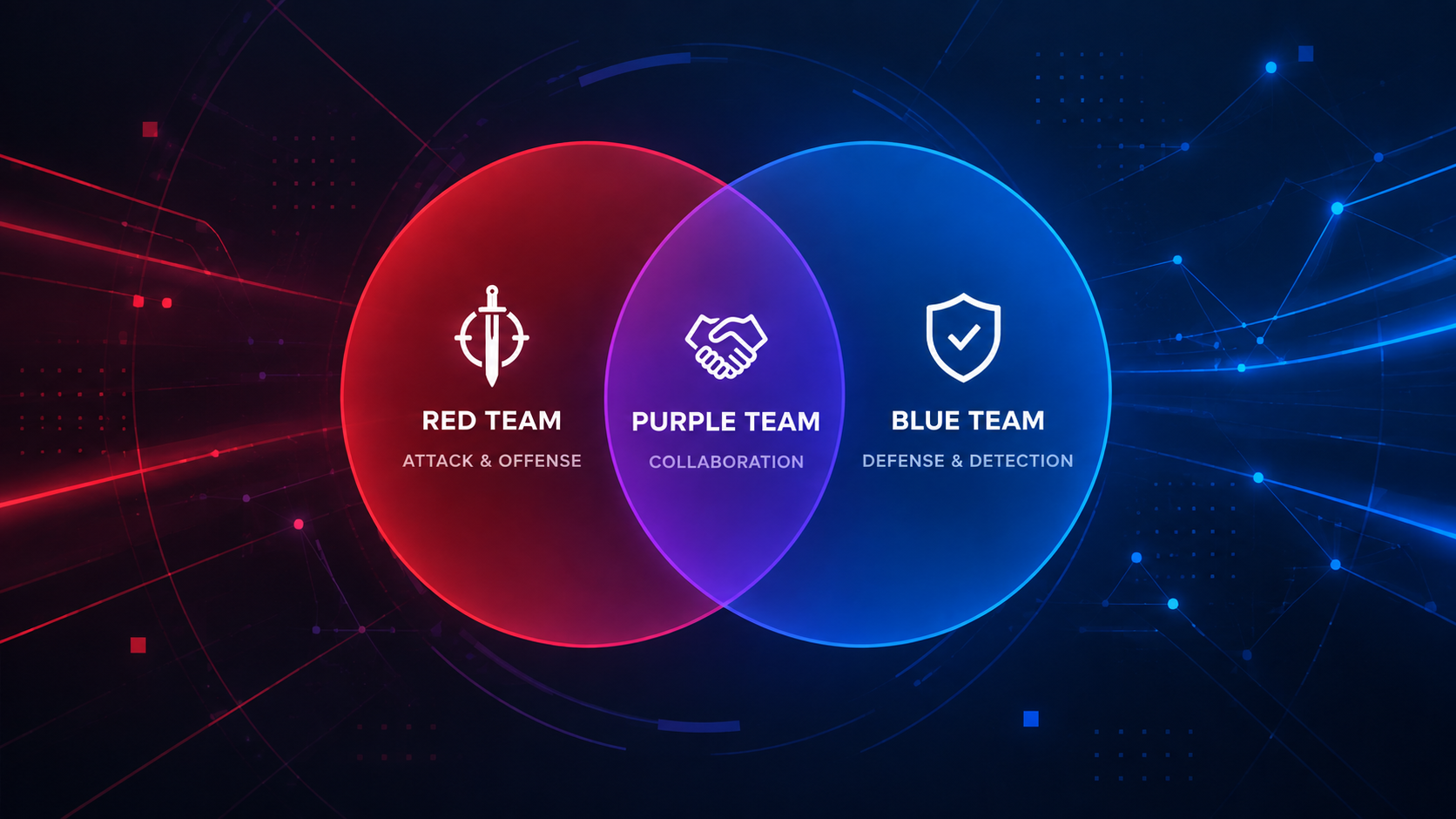
Red Team, Blue Team, and Purple Team Automation Explained
If you've ever wondered why security folks talk about colours like they're describing a paintball match, here's the breakdown.
- Red team plays the attacker. Their job is to break in, avoid detection, and prove what damage is possible.
- Blue team plays the defender. They monitor, detect, and respond to whatever the red team throws at them.
- Purple team isn't really a separate team at all. It's the collaboration layer, where red and blue work together in real time, sharing findings so defences actually improve rather than everyone just filing reports nobody reads.
Red Team Automation
Automated red teaming runs continuous adversary simulation, mapped to frameworks like MITRE ATT&CK, so your team always knows which attacker techniques were tested and which weren't. Instead of one red team exercise a year, you get a rolling programme that never really stops checking your blind spots.
Blue Team Automation
On the flip side, blue team automation focuses on detection and incident response. Think automated alert triage, SOC automation, and tools that cut down the painfully slow process of figuring out whether an alert is real or just noise. Given that security analysts already drown in alerts, this isn't a luxury, it's survival.
Purple Team Automation
Purple team automation is where things get genuinely interesting. Instead of red and blue operating in silos and comparing notes weeks later, automated purple teaming platforms run simulated attacks and immediately show whether your defensive tools caught them. It closes the feedback loop almost instantly. That's the whole point of a purple team exercise, really: stop treating offence and defence like they're competing departments.
Continuous Security Validation and Continuous Penetration Testing
Here's a shift worth noticing. Security teams across Europe are moving away from the old "annual pen test, tick the compliance box, forget about it" mindset. Continuous security validation means your defences are being tested constantly, not once a year on a date a consultant happened to have free.
Why does this matter so much? Because your attack surface never sits still. New employees join, new cloud services spin up, new code ships every week. A test from March tells you very little about your risk in October.
How Much Does Automated Penetration Testing Cost?
Pricing varies a fair bit depending on the size of your environment and how the vendor structures things, but here's the general shape of the market:
- Entry-level automated tools often start in the low thousands of euros annually, particularly for smaller SaaS teams.
- Mid-market platforms typically run into the tens of thousands annually, scaling with the size of your attack surface.
- Enterprise-grade continuous platforms can run considerably higher, but they're replacing what used to be several separate consultant engagements a year, so the comparison isn't quite apples to apples.
Worth asking any vendor directly: is this priced per asset, per test, or as a flat subscription? That single question saves a lot of budget surprises later.
Is Automated Penetration Testing Safe to Run on Production Systems?
This is a fair worry, and a smart one to raise. Nobody wants their "security test" to be the thing that actually causes the outage.
Reputable platforms are built with production-safe guardrails. They avoid destructive actions, throttle aggressive testing, and give you kill switches to halt a test instantly. Still, the sensible move is to start in a staging environment if possible, build confidence in how the tool behaves, and then graduate to production testing once that trust is earned. It's not that different from learning to drive on quiet roads before merging onto the motorway.
Compliance: PCI DSS, SOC 2, and Automated Penetration Testing
For European businesses handling payment data or working toward SOC 2, this question comes up constantly. Can automated results actually satisfy an auditor?
Increasingly, yes, though it depends on the framework and the auditor's own comfort level. Many automated platforms now generate compliance-ready reports, and some pair automation with human-reviewed sign-off specifically to satisfy stricter standards. If compliance sign-off is your primary driver, check with your specific auditor before assuming automation alone covers it. Rules differ, and nobody wants that conversation happening the week before an audit deadline.
Can Automated Penetration Testing Replace Human Testers Entirely?
Not yet, and probably not for a while. Automation is exceptional at repetitive, scalable, pattern-based testing. It's still catching up on creative, business-logic-driven attacks, the kind that require a human to think, "wait, what if I just... tried this weird thing?"
The smartest security programmes out there don't pick one over the other. They automate the repeatable groundwork and let human testers focus their (expensive, limited) time on the genuinely tricky stuff.
What Are the Limitations of Automated Penetration Testing?
Worth being upfront about this, because no honest guide skips it:
- Weaker at detecting business logic flaws than experienced human testers
- Can generate false positives if not properly tuned
- May struggle with highly custom or unusual application architectures
- Still benefits from human validation before major compliance sign-off
None of these are dealbreakers. They're just reasons to treat automation as a powerful layer, not a total replacement for judgment.
Two Tools Worth Knowing
Out of the crowded automated security testing market, two platforms consistently come up in serious conversations among European security teams:
Cymulate is a well-established breach and attack simulation platform, built for continuously validating whether your existing security controls actually catch simulated attacks. It's a strong fit if your priority is proving your defensive stack works, not just assuming it does.
Skyhawk Security takes a cloud-focused, AI-driven approach to detecting and simulating attack paths across cloud environments, which makes it particularly relevant for teams whose infrastructure lives largely in AWS, Azure, or GCP rather than on-premises networks.
Neither tool replaces the other, and neither replaces a skilled human tester. They're pieces of a bigger puzzle.
Bringing It All Together
Automated penetration testing isn't about replacing your security team. It's about giving them superpowers, or at least giving them back the hours they used to spend on manual reconnaissance and repetitive testing. Pair that with red team automation to keep attackers honest, blue team automation to sharpen detection, and purple team collaboration to close the loop between the two, and you've got a security programme that actually keeps pace with how fast your business moves.
The old model of testing once a year and hoping for the best simply doesn't hold up against how quickly modern attack surfaces change. Continuous, automated validation isn't a trend. It's quickly becoming the baseline expectation.
So the honest suggestion here: don't wait for the next annual pen test to find out where the gaps are. Have a look at where automation could slot into your current security stack, whether that's Cymulate, Skyhawk, or another platform that fits your environment, and start closing the gap between what you think is secure and what actually is.
Your future self, staring down that next vulnerability backlog, will thank you.
Other News and Events from ViVeTech

What Is Indirect Prompt Injection? How Attackers Hijack AI Agents Through Web Content and Emails
Learn more

További híreink és eseményeink
Mi az az indirekt prompt injection? Így térítik el az AI ágenseket a webes tartalmakon és e-maileken keresztül
Olvasson tovább
Hírlevél feliratkozás

Sign up for our newsletter