

Understanding Fleet Cybersecurity

Picture a crisp Tuesday morning outside Munich. A logistics team manager sips coffee while tracking thirty heavy freight trucks rolling toward distribution hubs across Bavaria. Suddenly, the fleet tracking map flickers. Five trucks report identical engine error codes, while their GPS signals jump to a location two hundred kilometers away in the middle of the Baltic Sea. Nobody slashed tires or picked physical locks. Instead, someone thousands of miles away tapped into an exposed telematics port, sending fake data directly into the steering and braking modules.
Scenarios like this are no longer theoretical scripts from Hollywood movies. As commercial trucks, vans, delivery vehicles, and passenger trains get smarter, they turn into computers on wheels. Every connected sensor, cellular modem, and digital driver log adds convenience, but it also opens a new backdoor for hackers. If you lead an IT team or run tech operations in Europe, understanding fleet cybersecurity is essential for keeping your vehicles moving, protecting your cargo, and avoiding steep regulatory penalties.

What Makes Connected Fleets Vulnerable?
To defend connected transport systems, security teams need to understand how onboard hardware communicates. Older commercial vehicles relied on direct mechanical connections. Modern vehicles depend on dozens of small computers known as Electronic Control Units (ECUs). These units manage engine timing, braking systems, transmission controls, and cabin displays.
Internal vehicle components communicate through a wired network called the Controller Area Network, or CAN bus. Standard CAN bus communication carries data without native cryptographic authentication or message encryption. Modern vehicle designs use central gateways, firewalls, and network segmentation to shield safety systems from external hardware. However, if an attacker manages to bypass these gateway boundaries, unauthenticated internal messages can still create operational issues.
Common entry points that require monitoring include:
- Telematics Control Units (TCUs) transmitting location and diagnostic data to cloud portals over cellular links.
- Electronic Logging Devices (ELDs) and diagnostic OBD-II ports located inside vehicle cabs.
- Wireless channels used to send over-the-air software updates to onboard units.
- Short-range wireless connections, including Wi-Fi and Bluetooth, used in service depots and maintenance bays.
Fleet Threat Matrix
Protecting these entry points requires structured defense mechanisms. Encrypting telematics communications scrambles data moving between vehicles and cloud dashboards. Network segmentation keeps critical control units separated from non-essential cabin electronics. In addition, GNSS signal validation tools help detect fake satellite signals before delivery schedules get disrupted.
European Regulatory Frameworks
Fleet cybersecurity in Europe involves specific legal requirements alongside technical best practices. European regulatory bodies have established clear frameworks for vehicle manufacturing and transport network operations.
UNECE Regulation No. 155 (R155)
UNECE R155 requires vehicle manufacturers to establish and maintain a certified Cybersecurity Management System (CSMS) as part of the vehicle type-approval framework. The regulation defines processes for identifying, assessing, and mitigating cybersecurity risks across the vehicle lifecycle. Without this required type approval, affected vehicle types cannot be approved for sale or registration in EU member states.
UNECE Regulation No. 156 (R156)
UNECE R156 establishes requirements for manufacturers' Software Update Management Systems (SUMS). It ensures that software updates, including over-the-air patches, are tracked, verified, and delivered safely throughout the vehicle lifecycle within the type-approval system.
ISO/SAE 21434
ISO/SAE 21434 provides an engineering framework for managing cybersecurity risks throughout the vehicle lifecycle. It covers organizational governance, Threat Analysis and Risk Assessment (TARA), product development, production, operation, maintenance, and decommissioning. The standard defines risk management processes rather than mandating specific hardware technologies or testing methodologies.
The NIS2 Directive
Europe's updated Network and Information Security Directive (NIS2) applies to designated entities in the transport sector, including railway undertakings, railway infrastructure managers, and specified road-transport or intelligent transport system operators, subject to national implementation. NIS2 places cybersecurity governance responsibilities on management bodies of covered entities, requiring executive oversight and approval of cybersecurity risk-management measures.
European Compliance Frameworks
Specialized Security Platforms for Transport
Standard office firewalls and endpoint antivirus software cannot protect moving commercial trucks or electric passenger trains. Transport hardware requires specialized security tools built for vehicle networks and live telemetry streams.
Enigmatos
Enigmatos provides cybersecurity solutions designed for commercial road fleets and heavy transport vehicles. According to vendor documentation, its platform monitors and analyzes in-vehicle CAN-bus and network messages to detect unauthorized commands, diagnostic anomalies, and rogue hardware attachments. This capability helps operators maintain visibility over internal vehicle activity across mixed commercial fleets.
Cervello
Cervello focuses on railway transport and rolling stock networks. Modern trains rely on a combination of operational technology, onboard sensors, and trackside signaling systems. Cervello provides passive network monitoring across train controls, signaling systems, and rail infrastructure, offering capabilities that support rail operators in meeting NIS2-related cybersecurity requirements.
Implementing a Vehicle Security Operations Center (vSOC)
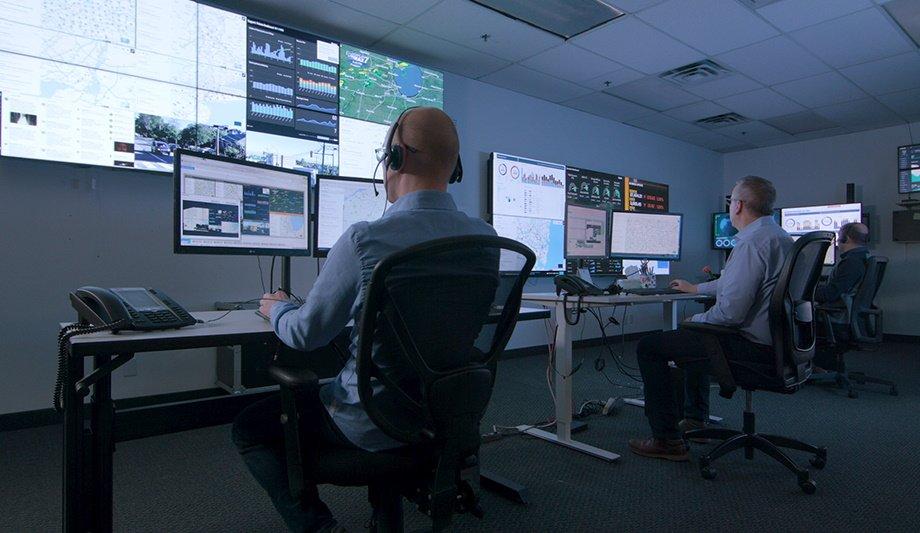
Monitoring stationary office servers differs significantly from tracking hundreds of connected vehicles moving across international borders. To maintain visibility, enterprise transport teams use a Vehicle Security Operations Center (vSOC).
A vSOC functions as a dedicated monitoring hub focused on vehicle signals, telemetry feeds, and diagnostic logs. Analysts in a vSOC look for operational anomalies, including:
- Unexpected message traffic on internal vehicle networks.
- Unverified software updates attempting to transmit to fleet hardware.
- Inconsistent location reports that indicate GNSS spoofing or telematics tampering.
- Unauthorized diagnostic logins during non-scheduled maintenance periods.
When a potential security incident occurs, the vSOC team follows established containment procedures. Rather than making abrupt remote shutdowns that could create safety hazards, analysts work to isolate affected telematics modules, preserve telemetry logs for investigation, coordinate with vehicle manufacturers, and maintain clear communication with drivers.
Protecting Your Fleet Moving Forward
Connecting vehicles to cloud platforms provides clear operational benefits, including lower fuel consumption, improved route planning, and faster maintenance diagnostics. Managing the accompanying digital risks requires a structured approach to vehicle hardware and network management.
Understanding fleet cybersecurity helps European IT managers and transport leaders protect operational assets. By assessing network entry points, following relevant regulatory standards, and using specialized monitoring tools, organizations can build secure and reliable transport operations.
Review your current telematics architecture, verify vendor compliance details, and ensure your vehicle networks receive the same defensive attention as your enterprise IT infrastructure.
Frequently Asked Questions
What is fleet cybersecurity?
Fleet cybersecurity involves the software tools, hardware defenses, and operational policies used to protect connected vehicles, telematics hardware, and fleet management platforms from unauthorized access and digital threats.
Why do modern connected vehicles face cyber risks?
Commercial vehicles depend on cellular modems, satellite positioning, and cloud management systems. Protecting these connections prevents remote manipulation, cargo loss, system downtime, and data exposure.
What are the primary entry points for vehicle attacks?
Attacks usually target cellular telematics units, diagnostic OBD-II ports in vehicle cabs, Electronic Logging Devices (ELDs), unencrypted Wi-Fi or Bluetooth connections, and wireless software update channels.
How does CAN bus communication work?
The CAN bus is an internal wired network that allows vehicle components to exchange data. Standard CAN bus protocols do not include native message encryption or authentication, which makes network segmentation and gateway protection necessary.
Who must comply with UNECE R155?
UNECE R155 applies directly to vehicle manufacturers seeking type approval to sell connected vehicles in participating markets, requiring them to operate a certified Cybersecurity Management System (CSMS).
What is the focus of UNECE R156?
UNECE R156 defines requirements for a manufacturer's Software Update Management System (SUMS), ensuring that vehicle software updates are verified, tracked, and securely delivered.
What does ISO/SAE 21434 cover?
ISO/SAE 21434 provides a framework for managing automotive cybersecurity risks throughout the vehicle lifecycle, establishing processes for governance, risk assessment, development, and maintenance.
Does the NIS2 Directive apply to all logistics companies?
No. NIS2 covers specific transport entities, such as railway undertakings, infrastructure managers, and designated intelligent transport system operators, based on sector criteria and national implementation laws.
How does a Vehicle Security Operations Center (vSOC) support fleet safety?
A vSOC collects and analyzes real-time telemetry, location data, and network logs from moving vehicles, allowing security teams to detect anomalies, investigate threats, and coordinate responses.
What steps should a security team take during a fleet incident?
Security teams should follow incident response plans to contain affected systems safely, preserve telemetry logs, notify relevant connectivity providers or manufacturers, and maintain safe communication with vehicle operators.
Other News and Events from ViVeTech

What Is Indirect Prompt Injection? How Attackers Hijack AI Agents Through Web Content and Emails
Learn more
What Is Automated Penetration Testing? A Guide to Red, Blue, and Purple Team Automation
Learn moreTovábbi híreink és eseményeink
Mi az az indirekt prompt injection? Így térítik el az AI ágenseket a webes tartalmakon és e-maileken keresztül
Olvasson tovább
Hírlevél feliratkozás

Sign up for our newsletter